
Alix is a Senior Product Manager at Travalyst responsible for the organisation’s transport sustainability strategy.
Travalyst is an independent not-for-profit working to change the way the world travels – for good. They partner with leading travel and technology companies to share trusted sustainability data, and empower travellers, businesses, and policymakers to make informed choices and accelerate impact-led change. To learn more, visit travalyst.org.
1. It must have been very satisfying to see the recent news that the Travel Impact Model (TIM) has been endorsed by the UK’s Civil Aviation Authority (CAA)? Tell us a bit about the journey to get here.
Yes, this was very exciting! And great to see the recognition after all the hard work that has gone on in this space by Travalyst and its partners over the years.
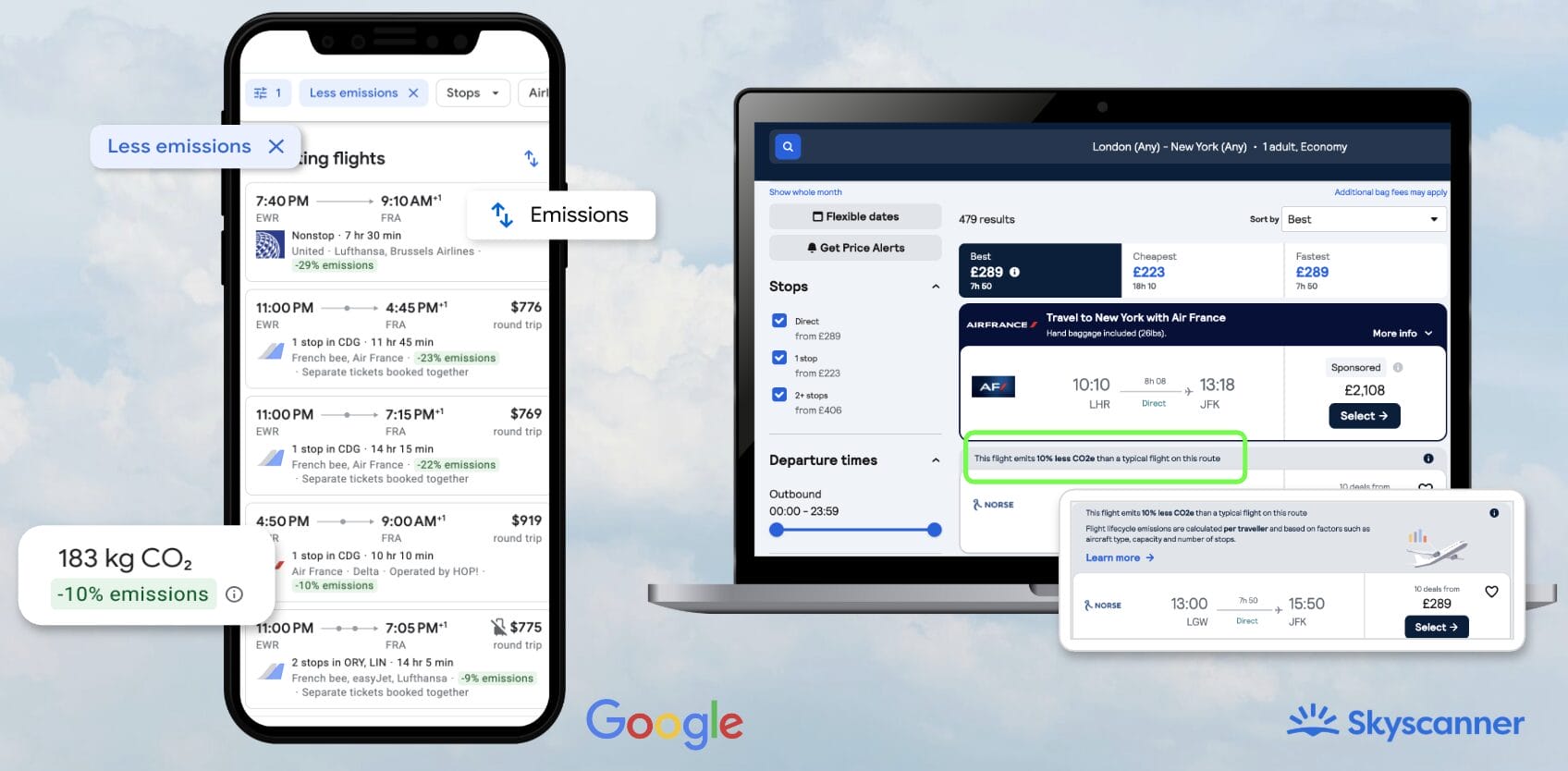
The TIM, which estimates lifecycle emissions for flights, was developed by Google in collaboration with Travalyst. Platforms using the TIM present flight emissions information at the point of booking, so travellers are able to choose a flight with an estimated lower-than-typical carbon dioxide equivalent (CO2e) footprint.
The TIM is not only scientifically robust because of oversight by an independent advisory committee led by the International Council on Clean Transportation (ICCT), but is also free and open access for the industry - a critical feature that we think has enabled aviation emissions information to scale. In fact, we know that emissions information has been seen in over 130 billion flight searches and has truly worked its way into the mainstream flight booking experience.
One of the reasons we started this work was not to create yet another “new” emissions framework for the industry but instead to create alignment among the major players, starting with our partners Google and Skyscanner who each had an emissions model at the time, with an aim to build more trust and credibility for travellers. But another critical piece to this is also aligning with regulatory bodies, which is why the endorsement from the CAA is so valuable.
2. What are the core objectives of the CAA framework and why are they important?
The “Consumer Environmental Information” framework released by the CAA aims to both increase the availability of aviation emissions information at the point of sale as well as bring greater consistency in the information available to consumers by endorsing a limited number of established methodologies, including the TIM. This is a voluntary framework, but we do hope it helps promote the use of aviation emissions information on booking platforms because we believe that this information has the potential to influence behaviour in a positive way.
And this is backed up by recent research released by the UK’s Department for Transport (DfT). The study looked at how seeing aviation emissions information, packaged in a range of labels or simply as a CO2e number, impacted the booking behaviour of participants. The results showed that the presence of all carbon labels and the numeric carbon information increased intent to select lower emissions flight options over the control sample. It is excellent to see these results, although we still need to do further testing in real-world scenarios.
3. How would you compare the UK’s approach with that of the EU?
While both programmes are currently voluntary, and have at their core an aim to increase transparency around flight emissions, EASA and the EU have taken a much more prescriptive approach than the UK and the CAA. The Flight Emissions Label (FEL) project is a result of the ReFuelEU legislation, and it is a practical initiative to support the uptake of lower emissions fuels by building consumer transparency around them. EASA has built a system for taking real fuel burn and SAF data from airlines and creating verified emissions information that can be displayed at the point of sale, so, unlike the UK, they are doing the calculations themselves and releasing their own label.
We are, of course, supportive of an initiative designed to increase awareness and transparency in this space, and in collaboration with EASA, the TIM will distribute the output data of the FEL directly so that there is alignment.
But with both programmes, we currently face a period of seeing if guidance and voluntary participation will turn into action. On the FEL side, we know that EASA is currently running a pilot with Air France-KLM and are eager to see what will come of that, and how they will build more participation in future.
4. How does the TIM work with the FEL, and what do you see as the key challenges for carbon emissions labels?
We have worked quite closely with EASA for a number of years, and followed the development of the FEL. EASA also has a non-voting seat on the Travel Impact Model Advisory Committee, so there is close communication between the two groups. When the data from the FEL is ready, the TIM will be a distributor of that data, such that anyone using the TIM for emissions information will be able to seamlessly get the FEL verified emissions as well, and we’re really pleased that this will make consuming that information much easier for third parties in the industry.
Where the challenges lie, for the FEL but also more widely, is with displaying the information to consumers. The data itself has come such a long way in terms of accuracy and rigour since we started this work, and I’m reasonably confident that it will only get clearer and more readily accessible in the coming years. But that’s only the foundation; ensuring that those making decisions around more sustainable travel actually understand emissions and how to use them is the next critical piece. So we broadly know that showing emissions to consumers is important, but there are many potential variations in how we do that, and still many open questions on the best communication methods and ways to design user interfaces to convey that information.
One of the most interesting findings from the UK DfT’s research was that travellers found the labels to be helpful even if they didn’t fully understand all of the data behind them. This shows that there’s potential for us to make a difference even in incremental steps – we don’t need a completely carbon literate public as a prerequisite for empowering more sustainable travel choices.
5. How important is international alignment on flight emissions data in practice?
I think it’s important to remember that most companies that sell flights are doing so internationally and not only within a single market. Having confusing or conflicting legislation ultimately acts as an obstacle not only to compliance, but also to innovation. So for us, and for our partners, it's important to ensure clarity and alignment globally so we have the space to ensure we are thinking about the most impactful ways to communicate with travellers about sustainability in their flight choices, and ultimately ensure the aims of the legislation come to fruition.
To that end, Travalyst will be engaging with partners and organisations in other jurisdictions to encourage alignment around existing methodologies and discourage the introduction of new, competing calculators and methodologies. We also work with our many industry collaborators, like IATA and EASA, to align wherever possible and ensure anyone booking travel is getting credible and consistent information.
6. What’s next for Travalyst’s transport team?
As a big fan of long-distance train travel myself, I’m thrilled that our next big step for transport will be looking at how we support growth in rail journeys. Both leisure and business travellers should not only be able to evaluate which flights have lower emissions on their route, but also which alternative low-emissions modes of transport are available to them. We’ll start by introducing a rail emissions data set to empower those comparisons.
One of Travalyst’s strengths is also in promoting cross-sector collaboration opportunities. So much of what happens in sustainability in the travel industry happens in silos – but how could we be more effective by bringing together stakeholders to work together, understand where needs overlap, and create projects that achieve more than any one organisation or vertical could do alone? For example, destinations rely on aviation to bring in visitors from both the leisure and corporate sectors, but the industry doesn’t have a clear sense of shared accountability for aviation emissions or an agreed way to account for them in destination climate action plans. Similarly, destinations face many risks as a result of climate change that aren’t fully understood by the airlines that fly to them; could we create a set of data that allows for risk visibility and shared action? We’re in the early days of these conversations with both coalition and strategic partners, but I’m excited to see lots of potential there.